
Amber Tarot Review by Life Spirit Team
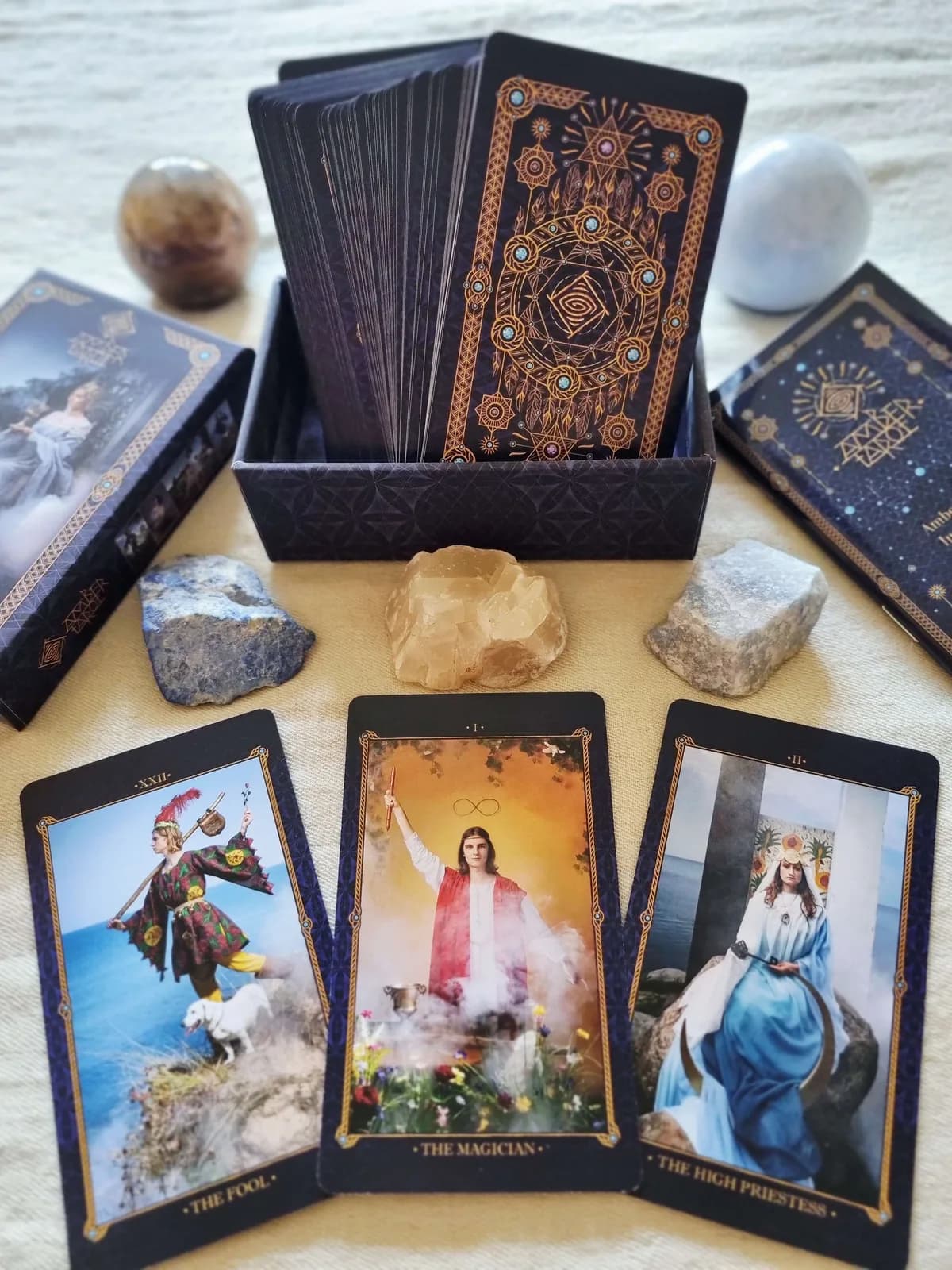
Bringing the Rider-Waite-Smith Tarot to Life
There are Tarot decks that reinterpret the traditional cards, decks that completely reinvent them and then there is Amber Tarot.
The Amber Tarot was brought to life by the Life Spirit Team, a collaborative group of professionals:
Denis Dyshlovenko, the photographer, has over 15 years of experience in film photography and optical printing, driving the deck's unique analog approach.
Anastasia Dyshlovenko, a certified tarologist and Kundalini yoga instructor, guided the esoteric aspects.
Sofia Karulina, an actress and model, served as the art director, bringing her artistic vision to the staged scenes.
Vladimir Kamchits, an experienced artist-designer, handled the branding, illustrations and printing layout, ensuring a cohesive visual identity for the project.
Amber Tarot takes a rather extraordinary approach, instead of creating a new artistic interpretation of the Tarot, the Life Spirit Team set out to bring the familiar Rider-Waite-Smith Tarot into the physical world.
The result is a 78-card photographic Tarot deck in which real people, real costumes, real props, real scenery and real locations recreate the imagery of the traditional Tarot and when I say real, I mean really real.
No AI-generated imagery. No Photoshop composites. No digitally constructed scenes.
The cards were photographed on film.
It is this commitment to traditional photography, combined with an extraordinary amount of practical preparation, that gives Amber Tarot its particular charm.
For anyone learning Tarot, there is another important advantage: the deck remains extremely close to the familiar Rider-Waite-Smith visual language. If you already own a Rider-Waite-Smith guidebook, or Liz Dean's 'The Ultimate Guide To Tarot', then you already have a useful companion for Amber Tarot.
That makes this a particularly interesting deck for Tarot beginners.
But before we look at how easy the deck is to learn, it is worth appreciating just how much work went into making it.
From Pamela Colman Smith's Drawings to Real Life, the Rider-Waite-Smith Tarot, first published in 1909, has become one of the most influential Tarot systems in the modern Western Tarot tradition.
The imagery created by Pamela Colman Smith, under the direction of Arthur Edward Waite, has become so familiar that many Tarot readers can recognise a card from just a handful of visual clues.
The Fool standing at the edge of a precipice.
The Magician with the four tools of the Tarot.
The High Priestess seated between her pillars.
The Lovers beneath the angel.
The Chariot with its contrasting sphinxes.
The Seven of Swords and the figure carefully carrying away his stolen swords.
The Ten of Cups beneath the rainbow.
These visual stories are the foundation upon which countless modern Tarot decks have been built. Amber Tarot takes those stories and asks a wonderfully simple question:
"What if we recreated them in real life?"
That simple idea turned into an enormous undertaking!
Life Spirit Team describes the project as involving more than 100 people and 70 costumes, with 92 photoshoots taking place over just three months.
The team also describes countless sleepless nights spent sewing costumes and preparing scenery.
The later production material gives an even greater sense of the scale of the undertaking, describing five months of shooting, four months of design and three months preparing for printing.
In other words, Amber Tarot was not simply a case of finding a few models, putting them in costume and taking some photographs.
This was closer to producing a small scale film.
Costumes, Props, Sets and Practical Magic
One of the things I particularly love about Amber Tarot is that the photographic process is not merely a gimmick. The practical construction of the scenes is part of the personality of the deck.
The Life Spirit Team selected models, costumes, locations and accessories for individual cards, deliberately attempting to preserve the visual details and symbolism of the original Rider-Waite-Smith imagery.
That means that when you look at a card, you are not simply looking at a photograph that happens to resemble the original. There has been an enormous amount of preparation behind the photograph. Costumes had to be made or sourced, jewellery and accessories had to be found.
Props had to be created,
locations had to be selected.
Scenes had to be constructed,
models had to be arranged, animals became part of the process too.
Then everything had to be captured at the right moment on film.
The Life Spirit Team even used smoke machines during the photography sessions. This was not digital mist added afterwards; the smoke was physically present during the shoot, helping to create a consistent atmospheric quality across the deck.
There is something rather magical about that.
In an age when almost anything can be created digitally, Amber Tarot went in the opposite direction. If they wanted a particular atmosphere, they created it. If they wanted a particular object, they found or built it and if they wanted a particular scene, they staged it.
Then they photographed it.
The Seven of Swords: An Example of the Detail
One of the best examples of this approach is the Seven of Swords.
In Pamela Colman Smith's original image, we see the central figure sneaking away from a military camp carrying five swords, while two remain behind.
It is an immediately recognisable scene. For Amber Tarot, the Life Spirit Team did not simply suggest the idea of a camp.
They created one.
According to the team's own account, they built a tent city in a historical settlement, sourced real swords and armour and included a sleeping guard in the distance. The intention was to preserve the small but important narrative detail from the original card: someone has apparently slept through the theft.
This is precisely what makes Amber Tarot so much fun to examine. You can look at a familiar card and then start asking:
How on earth did they make that?
That curiosity can become part of learning Tarot.
No AI. No Photoshop. Just Photography
For The Guilded Veil, this aspect of Amber Tarot is particularly worth highlighting.
The deck was created using film photography, with the Life Spirit Team explicitly stating that the cards were produced without Photoshop, computer graphics or artificial intelligence.
The result is therefore fundamentally different from a digitally illustrated Tarot deck.
There is no opportunity to simply move a person, alter an object or change the lighting afterwards with a few clicks.
The scene had to work in front of the camera.
The photograph had to capture it and once the photograph was taken, the physical reality of that moment became part of the finished image.
The Life Spirit Team has also explained that the use of film was intentional, including their interest in the qualities of silver halide film and the distinctive sense of reality created by analogue photography.
“Crafted on film and imbued with the mystical power of silver, a metal known to infuse magic into everything” Amber Tarot, Life Spirit Team
Whether or not a reader shares the team's more mystical ideas about film and silver is entirely personal. What is undeniable is that the use of analogue photography gives the deck a particular atmosphere.
There is texture.
There is warmth.
There is a sense of physical space.
There is the wonderful in the knowledge that someone actually stood there and photographed this scene.
A Modern Rendition of a Classic Tarot
Despite all this elaborate production, Amber Tarot is not trying to make you learn a completely new Tarot system.
That is one of its greatest strengths for a beginner.
The Life Spirit Team describes the deck as reproducing the classic Rider-Waite deck.
The Major Arcana follows the familiar sequence and symbolism, while the Minor Arcana retains the recognisable scenes and narrative structure that make the Rider-Waite-Smith system so accessible.
This is important.
Some Tarot decks require you to learn a completely new visual vocabulary. You may know what the Three of Cups traditionally means, for example, but find yourself staring at a completely different image and wondering how the artist has interpreted it.
Amber Tarot largely removes that barrier.
You can look at the Three of Cups and recognise the underlying story.
You can look at the Five of Pentacles and understand the visual language.
You can see the Eight of Swords and immediately identify the central theme of restriction and limitation within the image.
The imagery teaches you.
That makes Amber Tarot a very approachable deck for someone beginning their Tarot journey.
Amber Tarot for Tarot Beginners
If you are buying your first Tarot deck, one of the biggest challenges can be choosing a deck that gives you enough visual information to learn from without overwhelming you.
This is where Amber Tarot fits beautifully.
Because it closely follows the Rider-Waite-Smith imagery, a beginner can use the deck alongside almost any traditional RWS-based Tarot book.
That opens up a huge library of learning resources.
You don't need to find a specialist Amber Tarot book before you can begin. You can take a traditional Rider-Waite-Smith guidebook, shuffle your Amber Tarot deck and start learning. Read the traditional meaning. Look at the Amber Tarot photograph. Then compare the two.
What has remained the same?
What catches your eye?
What does the photographic version make you notice that you had previously overlooked?
This is an excellent way to develop Tarot intuition.
Rather than simply memorising 78 definitions, you begin to understand why the images tell the stories they do.
The Fool: 0 and 22
There is one interesting structural detail worth mentioning for anyone studying the deck. In Amber Tarot, The Fool appears as card 22 of the Major Arcana rather than being numbered 0 in the conventional position. At first glance, a beginner might wonder whether this creates a problem.
I do not think it does.
The Fool has always occupied an unusual position within Tarot.
Conceptually, The Fool can be understood as both the beginning and the end of the journey.
As 0, the Fool stands before the journey begins: unlimited possibility, innocence, potential and the willingness to step into the unknown. As 22, the Fool can be understood as returning to the beginning after travelling through the entire Major Arcana.
The World completes the cycle and the Fool begins again.
So while the numerical placement is different from the way many modern RWS readers first encounter the deck, it does not prevent the card from functioning perfectly well within the Major Arcana. In fact, for a beginner, it offers a lovely opportunity to understand something fundamental about Tarot:
-
Tarot is cyclical rather than simply linear.
-
The journey doesn't necessarily have a final destination.
-
We arrive, complete a cycle and begin again.
The Fool is both the traveller and the journey's potential to begin anew.
Learning the Minor Arcana
Another major advantage of Amber Tarot for beginners is its fully illustrated Minor Arcana.
The Rider-Waite-Smith tradition is particularly influential because Pamela Colman Smith illustrated scenes on the numbered Minor Arcana cards rather than relying solely on abstract suit symbols.
That means the cards can tell stories.
The Four of Swords shows a period of stillness and retreat.
The Five of Cups gives us an image of loss and disappointment while leaving something behind the figure.
The Six of Pentacles explores giving, receiving and the balance of resources.
The Eight of Cups depicts someone walking away from what they have known.
The Ten of Pentacles presents a rich visual story of family, legacy and material continuity.
For a new Tarot reader, these visual narratives are invaluable.
You can begin with the traditional meanings, but you can also simply look at the picture and ask:
What is happening here?
That question is one of the simplest ways to begin developing Tarot intuition.
A Deck You Can Grow With
A good beginner Tarot deck should ideally not become obsolete once you have learned the basics.
Amber Tarot has the potential to grow with you.
At the beginning, you might use the accompanying booklet and a traditional Rider-Waite-Smith guidebook. A few months later, you may find yourself relying less on the book and more on the images. Eventually, you may barely think about traditional keywords at all. Instead, you notice the expression of a character, the direction someone is facing, the landscape, the relationship between figures, the colours, the objects and the atmosphere.
That progression is one of the joys of learning Tarot.
Because Amber Tarot stays so close to the traditional imagery, the knowledge you develop with it can transfer readily to many other RWS-based Tarot decks.
Learn Amber Tarot and you are, in many respects, learning a visual language shared by a vast family of modern Tarot decks.
Looking at the Cards Differently
There is also something rather wonderful about using a photographic version of familiar Tarot imagery when you already know the Rider-Waite-Smith deck.
Photography changes the relationship between the viewer and the card.
Pamela Colman Smith's illustrations are stylised, symbolic drawings.
Amber Tarot gives us human beings inhabiting those same symbolic worlds.
A person suddenly has a face.
A costume has texture.
A sword has physical weight.
A building occupies space.
A landscape becomes somewhere you could potentially walk into.
This can make the cards feel surprisingly immediate.
The Tarot isn't being transformed into something completely different.
Instead, the symbolic language is being embodied.
And that is the real charm of Amber Tarot.
More Than a Photography Project
It would be very easy for a project like this to become primarily a photography exercise.
Beautiful photographs, elaborate costumes and dramatic scenery are wonderful, but a Tarot deck ultimately has to work as Tarot.
This is where Amber Tarot succeeds particularly well for readers who want a familiar system.
The Life Spirit Team's stated intention was to bring the Waite Tarot back to life while preserving as many of its original details as possible.
That distinction matters.
The photography serves the Tarot.
It doesn't replace it.
The images are spectacular, but underneath the costumes, sets, smoke and film grain is the familiar structure of the Rider-Waite-Smith Tarot.
For an experienced reader, that makes the deck immediately usable.
For a beginner, it provides a reassuring foundation.
Card Stock and Production
The physical deck is printed in Italy on 400 GSM card stock and finished with a smooth varnish. It comes in a silk-feel laminated two-thirds-lid box and includes a printed booklet containing card meanings (or in old school terms, little white book / LWB).
The Life Spirit Team also states that ecological materials were used in production.
The substantial card stock suits the nature of the deck, this is not an ephemeral collection of digital photographs.
The entire concept behind Amber Tarot is physical: physical people, physical costumes, physical objects, physical scenery and physical film.
Holding the finished deck therefore feels like the final stage of an enormous hands-on creative project.
Who Is Amber Tarot For?
Beginners
This is where I think Amber Tarot is particularly interesting.
If you are learning Tarot and want a deck that stays close to the Rider-Waite-Smith Tarot, Amber Tarot gives you a wonderfully visual starting point.
You can use traditional RWS meanings, spreads and books without needing to learn an entirely separate system.
Experienced Tarot Readers
Experienced readers may appreciate Amber Tarot for a completely different reason.
If you have worked with the RWS deck for years, seeing these familiar scenes recreated through photography can make you look again at cards you thought you already knew.
Sometimes changing the artwork is enough to reveal something you had stopped noticing.
Tarot Collectors
For collectors, the production story is arguably part of the deck's appeal.
A project involving more than 100 people, 70 costumes and 92 photoshoots in three months is extraordinary!
The deck is therefore not simply a collection of 78 Tarot cards.
It is the physical result of a huge collaborative photographic undertaking.
Photography Lovers
... And naturally, anyone fascinated by analogue photography, film photography, costume design, set design and practical effects is likely to find plenty to enjoy here.
The behind-the-scenes story is almost as fascinating as the finished cards.
Final Thoughts
Amber Tarot is an unusual combination of familiarity and spectacle.
At its heart, it is a Rider-Waite-Smith Tarot deck.
But around that familiar structure, the Life Spirit Team has built an extraordinary physical world.
-
People were brought together.
-
Costumes were made.
-
Jewellery and props were sourced.
-
Sets and scenery were prepared.
-
Locations were found.
-
Smoke machines were used to create atmosphere.
-
Animals became part of the photographic process.
Rather than creating the final images digitally, the team captured the scenes on film.
More than 100 people, 70 costumes and 92 photoshoots went into the project, with the main photographic work completed in just three months.
That dedication is visible in the finished deck.
For a beginner Tarot reader, Amber Tarot offers something particularly valuable: familiarity.
The imagery is close enough to the Rider-Waite-Smith tradition that traditional Tarot books can be used alongside it, making the learning process straightforward and accessible. For an experienced reader, the photographic interpretation provides a fresh way of looking at familiar archetypes. For anyone who appreciates the craft behind a Tarot deck, the story of how Amber Tarot was made is perhaps one of its greatest treasures.
This is Tarot brought out of the illustration and into the physical world.
It is real people inhabiting Pamela Colman Smith's visual language, photographed rather than digitally constructed.
Perhaps that is the simplest way to describe the magic of Amber Tarot:
It takes a Tarot deck that generations of readers already know and asks us to look at it as though, for the first time, those figures have stepped out of the cards and into the real world.
For more information about the creation of this amazing deck…
https://www.lifespiritteam.com/amberdeck