Golden Shadow Tarot: Three Tarot Spreads to Discover Your Hidden Gifts
Explore your Golden Shadow through three beginner friendly Tarot spreads designed to uncover hidden strengths, nurture creativity and embrace your potential.
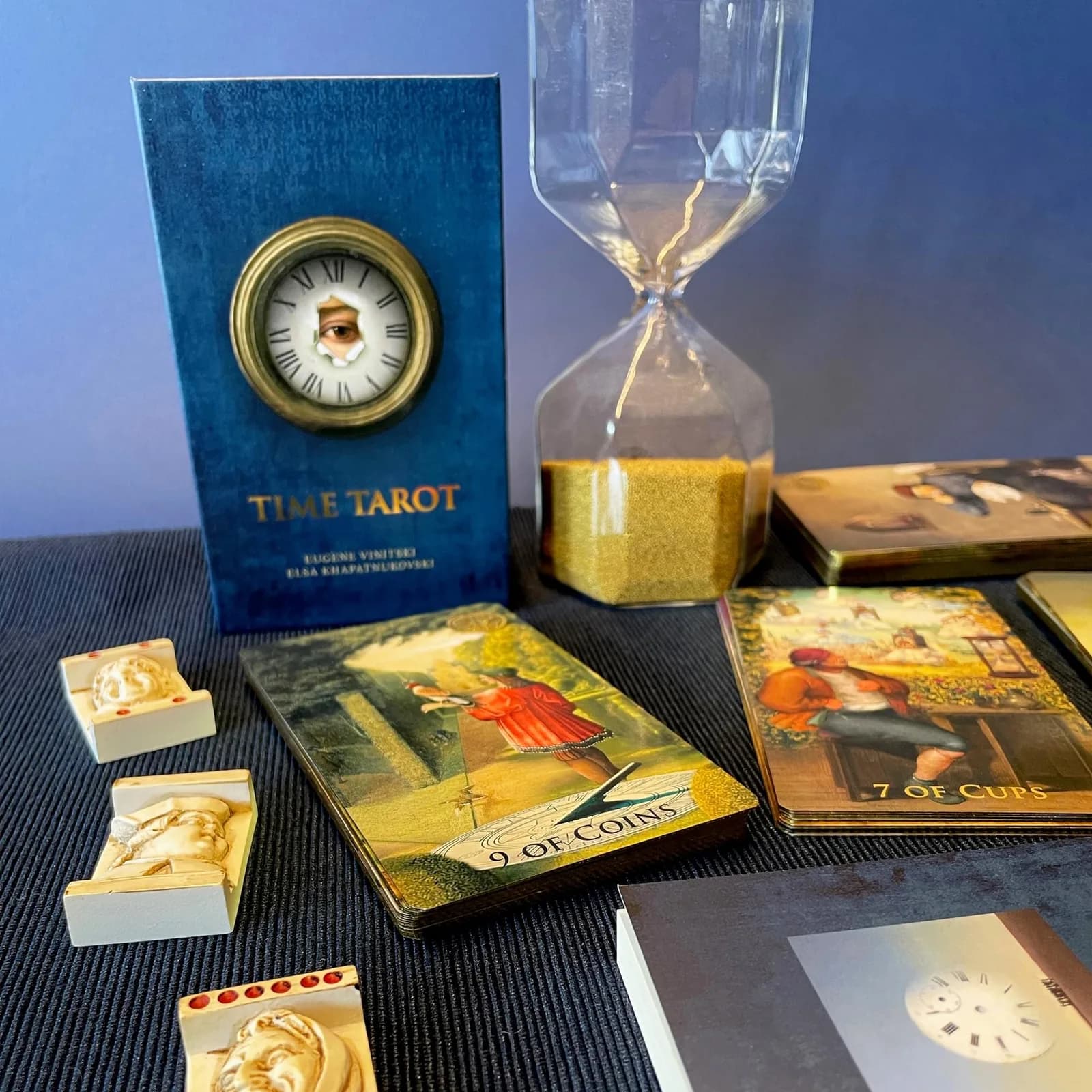
For this Journey Blog, we will be using the Time Tarot by Eugene Vinitski and Elsa Khapatnukovski.
In our previous article, Working with the Golden Shadow: A Tarot Guide to Discovering Your Hidden Gifts, we explored the idea that shadow work is not exclusively about confronting the difficult or uncomfortable aspects of ourselves. It can also involve recognising the strengths, talents and positive qualities we have overlooked, suppressed or never fully allowed ourselves to express.
Now, it is time to put that understanding into practice.
Tarot offers a wonderful opportunity to explore the Golden Shadow through imagery, symbolism and personal reflection. A card might remind us of a quality we admire, reveal a belief that has held us back, or encourage us to consider a possibility we have not previously given ourselves permission to explore.
In this article, we will work with three Golden Shadow Tarot spreads, each designed to explore a different aspect of self-discovery.
We will consider how to translate our insights into small, realistic actions that help us nurture the qualities we wish to develop. All of these exercises are designed to be beginner friendly Tarot spreads.
After the first two spreads we will look at a worked example, to help you see how the cards can communicate with each other.
We will begin by recognising and discovering our overlooked strengths, explore our relationship with creativity and confidence then finally consider how we might begin expressing our hidden gifts in everyday life.
You do not need to complete all three exercises in one sitting. You might choose one spread that resonates with you today and return to the others over the coming weeks.
Take your time, keep your Tarot journal nearby and allow yourself the freedom to explore without needing to find a particular answer.
The purpose of Golden Shadow Tarot is not to discover who you should become, but to explore who you might already be beneath the expectations, assumptions and limitations you have accumulated along the way.
Preparing for Your Golden Shadow Tarot Reading
Before beginning, find somewhere comfortable where you can spend a little time with your cards without interruption.
Choose a Tarot deck whose imagery invites you to reflect. You do not need a special Golden Shadow deck; any deck you feel comfortable using will work beautifully.
You may wish to light a candle, make yourself a cup of tea and spend a few moments settling into the present.
Take a few gentle breaths and consider the intention behind your reading.
Rather than asking the cards to tell you who you are, approach them as a means of exploring questions about your experiences, values, aspirations and possibilities.
Write down in your journal your immediate impressions before consulting a guidebook, if you use one. Notice which details in the illustrations attract your attention and what memories, feelings or associations arise.
There are no perfect answers to these exercises. Your interpretations may change as you reflect on them and that is perfectly natural.
With that in mind, let us begin.
1. Tarot Spread One: The Permission to Shine, A Four-Card Golden Shadow Tarot Exercise
Sometimes, the qualities we find most difficult to express are not our weaknesses, but our strengths. We may hide our creativity for fear of criticism, downplay our abilities to avoid appearing boastful, or make ourselves smaller because we worry about being judged. Over time, these experiences can make it difficult to embrace our positive qualities, even when we recognise them within ourselves.
This four-card Golden Shadow Tarot spread invites you to explore what you might be holding back, what makes it difficult to express and how you can begin to give yourself permission to shine.
The intention is not to force yourself into the spotlight, but to explore how you might express your authentic qualities with greater confidence and self-acceptance.
Find a quiet space, take a few slow breaths and shuffle your Tarot deck while reflecting on this question:
"Where in my life might I be holding back a positive quality or part of my potential?"
Draw four cards and arrange them in a diamond spread.
Card One: The Light I Keep Dimmed
What positive quality, ability or aspect of myself might I be holding back?
Consider qualities such as creativity, confidence, compassion, leadership or independence. Look at the imagery and notice what catches your attention before consulting the guidebook.
Card Two: The Shadow Around My Light
What belief, fear or expectation might make it difficult for me to express this part of myself?
Perhaps you worry about judgement, making mistakes or attracting attention. This card invites reflection, not self-criticism. There is no need to find a difficult explanation for every hesitation.
Card Three: The Truth I Need to Remember
What perspective might help me view this part of myself with greater kindness and balance?
Perhaps you do not need to be perfect before sharing your work, or confidence can grow through practice. Allow the card to suggest a fresh perspective rather than dictate an answer.
Card Four: One Step into the Light
How might I express this quality in a small, authentic and practical way?
Consider one manageable action, such as sharing a creative project, accepting a compliment or making time for something that brings you joy. Your step need not be dramatic.
Journaling Your Reading
Once you have considered each card, look at the four together as a connected story.
-
Which card surprised me most and why?
-
What beliefs or expectations might influence how I express myself?
-
Does the third card offer a fresh perspective?
-
What small step feels right for me?
Notice how the cards communicate with one another. Does the second card challenge the potential suggested by the first? Does the third offer a different perspective and does the fourth suggest a practical response?
There is no single correct interpretation. The purpose is to explore where you might give yourself a little more freedom to be who you are.
The Permission to Shine A Worked Example
Card 1, King of Wands Reversed
Card 2, Ace of Cups Reversed
Card 3, The Hierophant Upright
Card 4, Knight of Swords Upright
Card One, The Light I Keep Dimmed
King of Wands Reversed
The King of Wands is traditionally associated with creativity, vision, passion, leadership and the confidence to bring ideas into the world. He represents someone who possesses the ability to inspire others, take initiative and follow their own creative vision.
Reversed, however, this powerful energy may be turned inward or held back. Perhaps there is uncertainty about taking up space, expressing an opinion or allowing others to see what we are capable of.
The question here is whether we have unconsciously learned to contain our own strength. Have we mistaken confidence for arrogance? Have we become uncomfortable with recognition? Or perhaps we have become so accustomed to supporting everyone else's ambitions that we have forgotten to nurture our own?
The Golden Shadow asks us to consider whether our creative authority and natural leadership abilities are qualities we have been reluctant to acknowledge.
Sometimes we do not need to acquire a new quality. We simply need to reclaim one that has always been there.
Card Two, The Shadow Around My Light, Ace of Cups Reversed
The Ace of Cups represents emotional openness, intuition, compassion, creativity and the capacity to receive and express love.
Reversed, the waters may not be flowing quite as freely. There may be emotions left unexpressed, creative inspiration waiting to emerge or a reluctance to make ourselves emotionally vulnerable. Perhaps we fear disappointment, rejection or judgement. Perhaps we have learned that expressing our feelings makes us vulnerable, so we keep them safely contained.
Placed alongside the reversed King of Wands, this card becomes particularly interesting. We have two powerful energies being held back: the creative fire of the King and the emotional waters of the Ace. Could the difficulty be less about lacking ability and more about allowing ourselves to become emotionally invested in something we genuinely want?
The Ace of Cups invites us to reconnect with our emotional world and recognise that vulnerability is not necessarily a weakness. Our feelings, intuition and creativity are valuable parts of who we are. They deserve room to breathe.
Card Three, The Truth I Need to Remember, The Hierophant Upright
The Hierophant introduces another dimension to our reading. Traditionally associated with wisdom, teaching, established knowledge, traditions and belief systems, this card asks us to consider the influence of the rules and expectations we have absorbed throughout our lives. Where have we learned what is acceptable? Whose standards are we measuring ourselves against? And how much of our behaviour is shaped by beliefs that we have never really questioned? Perhaps we have been taught to behave in a particular way, to avoid drawing attention to ourselves or to seek approval before expressing our ideas.
The Hierophant can also represent the positive value of learning from others, developing our knowledge and drawing upon experience.
But there is an important distinction between learning from established wisdom and feeling that we must follow somebody else's path. We can respect tradition without being restricted by it. We can learn from teachers without surrendering our own judgement.
In this position, the Hierophant encourages us to examine the beliefs that influence our confidence and consider whether they still serve us. Perhaps the truth we need to remember is that we are allowed to develop our own understanding of who we are and what we have to offer.
Card Four, One Step into the Light
Knight of Swords Upright
Now we have movement!
The Knight of Swords is decisive, intellectually driven, courageous and eager to move forward. He represents determination, action and the willingness to pursue an idea. After two reversed cards and the reflective energy of the Hierophant, his arrival brings a noticeable change in momentum. Perhaps we have spent too much time questioning ourselves, waiting for the perfect moment or trying to establish whether we are sufficiently prepared.
The Knight suggests that sometimes we simply need to begin.
We do not have to become completely confident before taking action. Confidence can develop through experience and our abilities grow as we give ourselves opportunities to use them. His message is not necessarily to rush headlong into everything, but to recognise when reflection has served its purpose and a practical step is needed. Perhaps it is time to share that creative project, express an opinion, accept an opportunity or simply give ourselves permission to try something new.
We do not have to become the King of Wands overnight, we simply need to take the first step.
Reading Between the Cards: Let Your Tarot Spread Become a Conversation
This is where the diamond arrangement became particularly interesting. Rather than reading the four cards independently, I began looking at the relationships between them. What happens when we allow the cards to speak to one another?
The two reversed cards immediately caught my attention.
The King of Wands reversed suggests creative confidence and personal authority that may not be fully expressed. The Ace of Cups reversed suggests emotional energy, intuition and creativity that may also be struggling to find an outlet. Together, they suggest that something valuable is being held back. The Hierophant then introduces the possibility that our beliefs, expectations and learned behaviours may have influenced this reluctance. Finally, the Knight of Swords brings the energy of movement and action.
We begin with suppressed creative potential, explore the emotional barriers surrounding it, question the beliefs that may have contributed to those barriers and finish with an invitation to move forward.
There is a natural progression within the reading:
-
King of Wands reversed: I am holding back my creative power.
-
Ace of Cups reversed: I am struggling to allow myself to feel and express it.
-
The Hierophant upright: I need to examine the beliefs and expectations influencing me.
-
Knight of Swords upright: I can choose to move forward.
Giving Every Part of Ourselves a Voice
What I find particularly interesting about this example reading is that it reminds us that our hidden gifts are not necessarily hidden because we lack confidence or ability.
Sometimes they are hidden because we have learned not to express them.
We may have become more comfortable demonstrating our strength than showing our vulnerability. We may value our achievements more than our intuition, or our ability to support others more than our own creative ambitions.
Golden Shadow work encourages us to look beyond these familiar patterns.
It asks us to recognise the positive qualities we may have overlooked, the parts of ourselves we have quietly diminished and the possibilities waiting to be explored.
Maybe the most important lesson from this little diamond-shaped reading is that we do not need to become someone else to shine. We need to make room for all that we already are. Perhaps the greatest permission to shine is allowing every part of ourselves to have a voice. Including the bits that do not shout quite so loudly.
2. Tarot Spread Two: The Hidden Gifts Within
Recognising Our Overlooked Strengths
Sometimes, we are so familiar with our own abilities that we barely notice them.
We may consider ourselves naturally organised, creative, patient, resourceful or compassionate without recognising the value these qualities bring to our lives and relationships. Equally, we may have learned to dismiss our strengths because they were not recognised by others, or because we have become accustomed to focusing on what we believe we lack.
This spread invites us to explore the positive qualities we may have overlooked.
The five-card spread
Card 1, A Strength I May Overlook
What positive quality might I be taking for granted?
Consider the everyday things you do without much thought. Perhaps you listen carefully, solve problems creatively, remain patient in difficult situations or notice details that others miss.
Card 2, Where This Strength Appears
How does this quality show itself in my everyday life?
Think about your relationships, work, creative pursuits and the way you respond to ordinary challenges.
Can you identify examples of this quality in action?
Card 3, What Makes It Difficult to Recognise?
What beliefs or assumptions might lead me to underestimate this quality?
Perhaps you compare yourself with others, believe that your abilities are not particularly special, or dismiss your achievements because something comes naturally to you.
Use this card to explore those assumptions without judging yourself for having them.
Card 4, How I Can Nurture This Gift
What would help me develop or appreciate this quality more fully?
Perhaps you need more time, encouragement, practice or permission to take yourself seriously.
Card 5, Sharing My Gift with the World
How might this quality contribute positively to my life or the lives of others?
This does not have to involve a grand achievement. Sometimes our greatest strengths appear in small acts of kindness, the things we create, the problems we solve or the way we support those around us.
Journaling exercise: Your personal inventory of gold
After completing the reading, make a list of five positive qualities you believe you possess.
If you find this difficult, think about compliments you have received, things people regularly ask you for help with, or situations in which you have handled something well.
Next, write down one example of each quality in action.
For instance:
-
Resourcefulness: I found a practical solution when a plan changed unexpectedly.
-
Creativity: I approached a familiar problem from a different perspective.
-
Compassion: I listened to someone without rushing to judge or advise them.
-
Perseverance: I continued working towards something that mattered to me.
-
Courage: I spoke honestly about something that was important to me.
Your examples do not need to be dramatic. Everyday evidence can be just as meaningful as exceptional achievements.
Return to this list whenever you find yourself focusing exclusively on what you believe you lack.
Recognising our strengths is not arrogance. It is an opportunity to develop a more balanced and realistic understanding of ourselves.
Worked Example of The Hidden Gifts Within
Card 1, The Wheel of Fortune, Upright
Card 2, Six of Wands, Upright
Card 3, The Empress, Upright
Card 4, Page of Pentacles, Reversed
Card 5, The Chariot, Reversed
Card 1, A Strength I May Overlook
Wheel of Fortune, Upright
What a wonderful card to sit at the centre! The Wheel of Fortune suggests an ability to recognise cycles, adapt to change and understand that life is constantly moving. Perhaps this person has an instinctive understanding of timing, knowing when to act, when to wait and when circumstances are ready to shift.
There may also be an overlooked ability to help others navigate change. They might naturally recognise patterns in situations and see possibilities where others see uncertainty.
The hidden gift here could be an innate understanding of life's ebb and flow and perhaps this person does not recognise it because it feels entirely natural to them.
Card 2, Where This Strength Appears
Six of Wands, Upright
Here we see the gift becoming visible.
The Six of Wands suggests that this ability to navigate change may manifest through leadership, encouragement and the capacity to inspire confidence in others.
Perhaps people naturally look to this person for reassurance or direction. They may have a way of helping others recognise their own achievements and encouraging them to keep moving forwards.
Interestingly, the Wheel's understanding of life's cycles becomes the Six of Wands' ability to help others recognise their progress.
Card 3, What Makes It Difficult to Recognise? The Empress, Upright
The Empress is abundant, nurturing, creative and generous. She represents someone who creates the conditions in which things can flourish. But perhaps this is precisely why the gift goes unnoticed. Nurturing, supporting, creating and encouraging others may be so deeply embedded in this person's nature that they don't consider these qualities particularly remarkable.
They may recognise these things as simply being what they do.
Yet the Empress reminds us that creating an environment in which other people can grow is an extraordinary strength.
There is also an interesting connection between the Wheel and the Empress: both understand growth, cycles and the natural unfolding of things.
Card 4, How I Can Nurture This Gift
Page of Pentacles, Reversed
Now this is an interesting little challenge! The reversed Page of Pentacles suggests that nurturing this gift may require a change in how we value our own abilities. Perhaps there is a tendency to underestimate what we know, dismiss our experience or feel that we need another qualification, another achievement or someone else's approval before taking ourselves seriously.
The invitation here is to stop treating natural abilities as though they are somehow less valuable because they come easily. There may also be a need to give these gifts more practical attention. To invest time in them, develop them and allow them to become something tangible.
Not every gift needs to be learned from scratch. Some simply need recognising and cultivating.
Card 5, Sharing My Gift with the World
The Chariot, Reversed
Here we have our final piece of the puzzle, The Chariot reversed suggests that sharing this gift may involve releasing the need to control the direction or outcome of everything.
Perhaps the person feels they must have a clear destination, a perfectly formed plan or complete confidence before allowing their abilities to be seen. But what if their greatest contribution comes from allowing themselves to be guided by their natural understanding of life's movement?
-
The Wheel understands the cycles.
-
The Empress nurtures growth.
-
The Six of Wands inspires others.
-
The Chariot reversed asks us to loosen our grip on the reins.
Perhaps the gift is not about leading everyone towards a particular destination. Perhaps it is about helping people discover their own direction.
The overall message
What strikes me most about this reading is the relationship between the cards. We begin with the Wheel of Fortune, representing an innate understanding of life's changing circumstances. That gift expresses itself through encouragement and leadership (Six of Wands), is rooted in nurturing and creativity (The Empress), but may be undervalued because it feels so natural (Page of Pentacles reversed). Finally, the Chariot reversed suggests that the next step is to stop trying to control how that gift should be expressed.
The hidden gift is not necessarily something we need to acquire. It may be something we have been doing all along without recognising its true value.
I particularly like something about this spread layout.
Card 1 touches every other card, so that it becomes the connecting force. The other four cards do not simply follow one another; they each offer a different perspective on the same underlying strength. That makes the spread feel much more like an exploration of a single hidden quality than five separate questions.
There's something beautifully cyclical about that. We discover a gift, recognise it, nurture it, encounter what holds it back and learn to release it.
But perhaps the most interesting thing is that the Wheel does not stop turning. This is not a destination or a fixed conclusion. It's an ongoing process of recognising and reclaiming ourselves.
I wonder whether the physical arrangement is actually teaching us something about the reading itself: our strengths don't exist in isolation. They influence one another, develop together and create something greater than the individual qualities.
3. Tarot Spread Three: Reclaiming Creativity and Confidence, Exploring the Parts of Ourselves We Have Set Aside
The Golden Shadow can sometimes include qualities we once expressed freely but gradually learned to suppress.
Perhaps you loved drawing as a child but stopped because you believed your work was not good enough. Maybe you once spoke your mind but became more cautious after experiencing criticism. Perhaps you dreamed of starting a business, learning an instrument or exploring a new direction but repeatedly postponed the idea.
Over time, we can become so accustomed to setting these things aside that we forget how important they once were.
This spread explores the relationship between a quality we wish to express and the practical steps that might help us reconnect with it.
Choose one quality, interest or aspiration you would like to explore. It could be creativity, confidence, independence, playfulness, leadership or something entirely different.
The six-card spread
Card 1, The Part of Me That Wants to Emerge
What quality, interest or possibility would I like to explore?
Allow this card to represent the part of yourself that is asking for attention.
Card 2, What Drew Me to It
Why does this quality or aspiration matter to me?
Consider what it represents and how it connects with your values, interests or sense of purpose.
Card 3, The Story I Tell Myself
What beliefs might be discouraging me from expressing this part of myself?
Perhaps you believe you are too old to begin, lack sufficient talent, have missed your opportunity or need to be perfect before you start.
Notice these thoughts without assuming they are necessarily true.
Card 4, What I Need to Acknowledge
What would help me understand my relationship with this quality more clearly?
This might involve recognising a fear, accepting a limitation, acknowledging a strength or giving yourself permission to want something.
Card 5, A More Supportive Perspective
What could help me approach this possibility with greater openness?
Look for a perspective that encourages exploration rather than perfection.
Card 6, My First Practical Step
What small action can I take to reconnect with this part of myself?
Choose something realistic and manageable. You might set aside half an hour for painting, enrol in a class, share an idea with someone you trust or simply allow yourself to imagine a different possibility.
Journaling exercise: Giving yourself permission
-
Write about the quality or aspiration you explored.
-
When did you first become interested in it?
-
What did it mean to you then?
-
Has your relationship with it changed over time?
Next, consider whether any assumptions have prevented you from exploring it further.
Finally, write a permission statement of your own.
For example:
-
I give myself permission to create without expecting perfection.
-
I give myself permission to learn something new without needing to be immediately good at it.
-
I give myself permission to explore an interest simply because it brings me joy.
Keep your statement somewhere you can return to it.
You do not have to transform your life overnight. Sometimes, a small act of curiosity is enough to begin reconnecting with a neglected part of yourself.
Working with Your Golden Shadow: A Few Gentle Reminders
Before finishing your readings, there are a few things worth remembering.
You do not have to complete every spread. Choose the exercise that feels most relevant to you. One thoughtful reading can be more valuable than four readings completed simply because they are available.
Your interpretation matters.
Tarot cards offer images and symbolism to explore, not definitive statements about your personality. If an interpretation does not resonate, you do not need to force it to fit. Admiration is not a test. You do not need to discover a hidden version of every quality you admire in others. Sometimes admiration simply tells us what we value or what we would like to learn.
You are allowed to take your time.
If a question brings up uncomfortable feelings, you can pause, leave the reading unfinished or choose a different exercise. You do not need to push yourself towards a breakthrough.
Tarot is a tool for reflection, not diagnosis or treatment. These exercises are intended to support self-awareness and personal exploration. They are not a cure for emotional distress or a substitute for appropriate professional support.
Your wellbeing always comes first.
Conclusion: Your Golden Shadow Is a Journey, Not a Destination
Working with the Golden Shadow through Tarot can be a gentle way to explore the qualities we admire, the strengths we overlook and the possibilities we have not yet allowed ourselves to consider.
Through these three spreads, we have explored admiration, personal strengths, creativity, confidence and the process of integrating positive qualities into everyday life.
You may have discovered something you had never consciously recognised before. Perhaps you have remembered a talent you once enjoyed, acknowledged a strength you usually dismiss or identified a quality you would like to develop.
Or perhaps the most valuable part of your reading was simply the opportunity to spend a little time considering what matters to you.
All of these experiences have their place.
The Golden Shadow is not about becoming perfect, achieving endless personal growth or turning every quality into something productive. It is about developing a more complete understanding of ourselves and allowing room for the parts of us that have been overlooked.
As you continue your Tarot journey, you might return to these spreads at different points in your life. Your answers may change as your circumstances, priorities and understanding of yourself evolve.
Let that be part of the process.
You do not have to become someone else to recognise your own gifts. Sometimes, you simply need to give yourself permission to notice them.
Perhaps the greatest gift of Golden Shadow work is learning to offer yourself the same appreciation, patience and encouragement that you so readily recognise in others.
And that is a beautiful place to begin.
Frequently Asked Questions About Golden Shadow Tarot
What is Golden Shadow Tarot?
Golden Shadow Tarot is the use of Tarot cards as a reflective tool for exploring positive qualities, strengths, talents and potential that we may have overlooked or not fully expressed. It can help us consider what we admire in others and how those qualities relate to our own values and aspirations.
How many cards should I use for a Golden Shadow reading?
There is no required number of cards. A simple three-card reading can offer a useful starting point, while larger spreads allow you to explore a topic in greater depth. The four exercises in this article use four, five and six cards respectively.
Can I use any Tarot deck for Golden Shadow work?
Yes. You can use any Tarot deck whose imagery you enjoy exploring. Choose cards that encourage you to reflect and make personal associations rather than feeling you must follow a particular interpretation.
How often should I practise Golden Shadow Tarot?
You might begin with one reading and allow yourself a week or two to reflect on it. You can return to a spread whenever a particular question or aspiration becomes relevant. There is no need to follow a rigid schedule.
Is Golden Shadow work the same as positive thinking?
No. Golden Shadow work is not about ignoring difficult feelings or insisting that everything is positive. It involves exploring qualities that may have been overlooked or suppressed while maintaining an honest understanding of ourselves, including our limitations and challenges.
Can Golden Shadow Tarot help me build confidence?
Tarot may support confidence-building by encouraging you to recognise your strengths, examine assumptions and identify practical steps towards expressing qualities you value. It is a reflective practice rather than a guaranteed method of changing how you feel.
If you enjoyed these exercises, you may also like our companion article, Working with the Golden Shadow: A Tarot Guide to Discovering Your Hidden Gifts, which explores the psychological ideas behind the Golden Shadow and how they relate to personal growth.
You can also explore our wider Shadow Work series for more Tarot exercises, journaling prompts and gentle opportunities for self-discovery.
Remember that shadow work does not always have to involve confronting painful experiences. Sometimes, it can be as simple as recognising a strength, rediscovering an interest or allowing yourself to imagine a new possibility.
Take what is useful, leave what is not and allow your journey to unfold at your own pace.
•♡• May your path be illuminated, your intuition trusted and your cards always reveal the wisdom you seek. Until next time… welcome to The Guilded Veil •♡•