
Liber Somnia Red Visions Tarot Review: Entering the Dreamscape
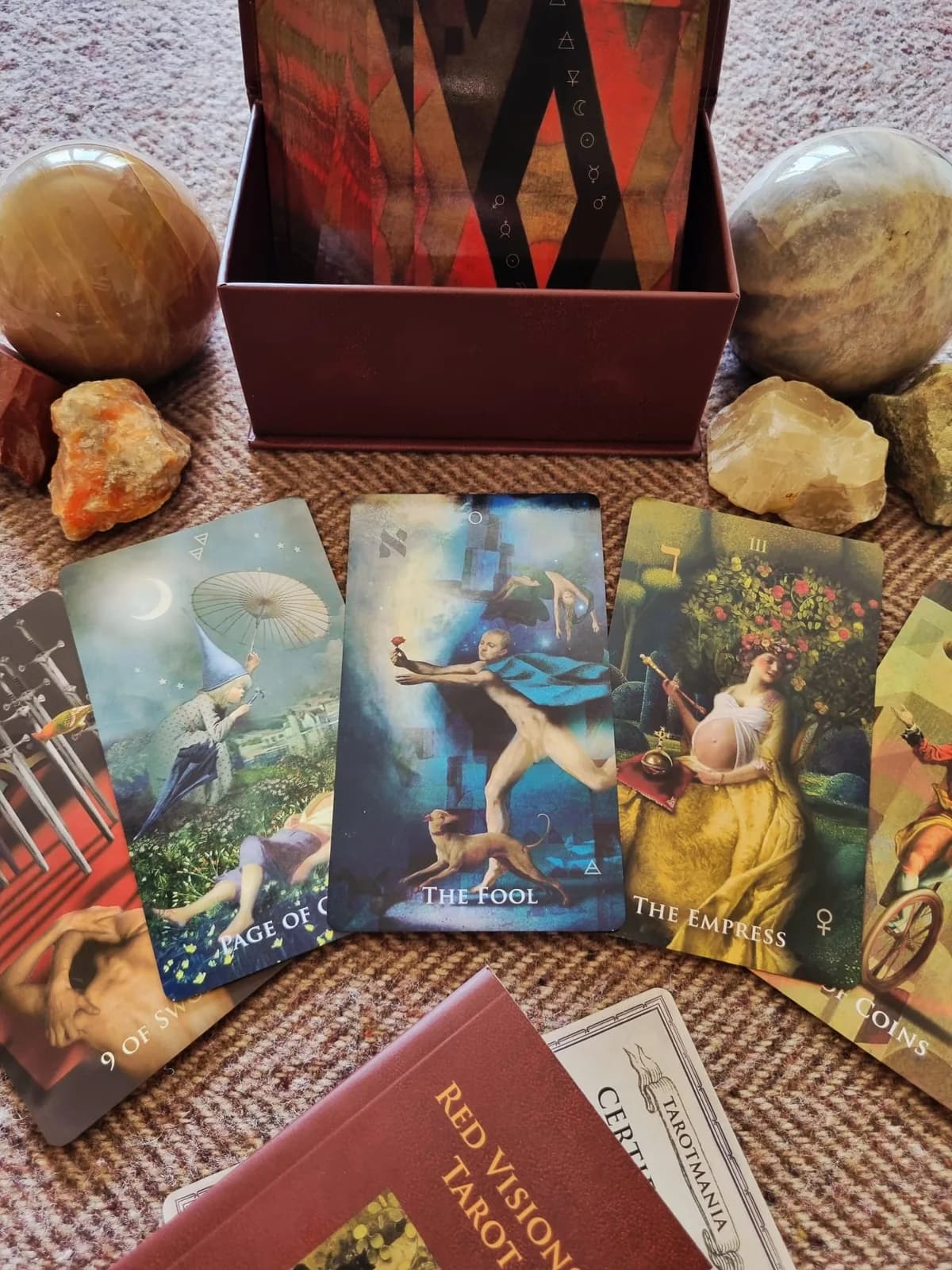
Liber Somnia Red Visions Tarot Review: Entering the Dreamscape of Eugene Vinitski and Elsa Khapatnukovski
There are Tarot decks that invite you to learn their language.
There are Tarot decks that ask you to follow their symbolism....
and then there are decks that seem to look back at you.
Liber Somnia Red Visions Tarot by Eugene Vinitski and Elsa Khapatnukovski of Tarotmania, belongs firmly in the third category.
Created this year 2026, hot off the shelf and already causing quite a stir in the indie created no ai Tarot community. This is not a Tarot deck that seems particularly interested in telling you what you should see. Instead, it creates a dreamlike psychological landscape in which the meaning of each card can emerge through feeling, association, tension, memory and intuition.
It is a deck about the inner world,
about what lies beneath the surface. About the strange places where dreams, archetypes, symbolism and the unconscious meet.
For readers interested in Jungian psychology, shadow work, dream interpretation, psychological Tarot and intuitive reading, Liber Somnia Red Visions Tarot offers an unusually rich experience. Yet beneath its psychological depth is something wonderfully simple: the invitation to sit with an image and ask yourself what it is saying.
Not what the book tells you.
Not what the card should mean.
But what is happening inside you as you look at it.
That is where Liber Somnia begins to reveal itself.
What Is Liber Somnia Red Visions Tarot?
Created by Eugene Vinitski
and Elsa Khapatnukovski of Tarotmania, Liber Somnia Red Visions Tarot follows the traditional 78 card Tarot structure of the Rider-Waite-Smith tradition, but its approach to imagery and interpretation is far removed from a conventional Tarot deck.
Rather than constructing each card around a collection of recognisable decorative symbols, Vinitski explores psychological states, inner processes and dreamlike situations. The deck is concerned with projection, transformation, tension, shadow and renewal. These are not simply concepts attached to individual cards. They become part of the atmosphere of the entire deck.
Liber Somnia feels as though it belongs somewhere between a Tarot reading and a dream journal.
The images do not necessarily hand you an obvious answer. Instead, they create a space in which your own psyche can begin participating in the reading. That is one of the things I find most compelling about this deck.
Tarot as a Reflection Than a Map
One of the most interesting ways to approach Liber Somnia is to think of it as a reflection rather than a map. A map tells us where we are going. A reflection shows us where we are, Liber Somnia does something similar.
You might draw a card and immediately recognise the traditional Tarot archetype beneath the imagery. But then something else happens. Your attention catches on a particular detail. Perhaps the expression of a figure unsettles you. Perhaps the composition creates a sensation of confinement, longing, transformation or uncertainty.
Suddenly the card becomes personal.
This is particularly powerful in shadow work Tarot readings.
Shadow work is not necessarily about discovering something terrible hidden inside ourselves. The shadow can contain emotions, desires, fears, memories, talents and aspects of our personality that we have learned to suppress, deny or overlook.
A Tarot deck that allows those things to surface without immediately imposing an interpretation can become a remarkably useful reflective tool.
Liber Somnia Red Visions Tarot seems to understand this instinctively.
The Jungian Influence of Liber Somnia
The influence of Carl Jung and Jungian psychology is central to the character of Liber Somnia.
Jung's work explored the unconscious mind, archetypes, dreams, symbolism and the process of individuation, the lifelong movement towards becoming more conscious of the different aspects of ourselves.
Liber Somnia approaches Tarot through a similar doorway.
Its archetypes are not treated as lifeless symbols that simply possess one predetermined definition.
Instead, they can be understood as living psychological forces.
That distinction matters.
-
The High Priestess, for example, is not simply "intuition".
-
The Devil is not simply "addiction".
-
The Tower is not simply "sudden change".
Those traditional keywords can be useful starting points, but the archetype is larger than the keyword. Liber Somnia encourages us to explore what the archetype means in this moment, within this particular person and within the emotional landscape created by the reading.
That is a very Jungian way of approaching Tarot.
When the Tarot Becomes a Dream
Perhaps the most beautiful quality of Liber Somnia Red Visions Tarot is its relationship with dreams. Dreams rarely explain themselves while we are having them. A dream can place us in an impossible landscape. Someone we know may appear as someone completely different. A house may represent something we cannot quite articulate. A door can become an invitation, a warning or simply a door. We wake up carrying the emotional residue of the dream even when its narrative makes very little logical sense.
Liber Somnia works in a similar way.
Its imagery does not always need to be immediately translated into a neat sentence. Sometimes it is enough to allow the image to work upon you. This makes the deck particularly fascinating for dream work and intuitive Tarot reading. You can draw a card before sleep and allow its imagery to become part of your dream landscape. You can pull a card after waking and ask what aspect of the dream it reflects. Or you can simply use the deck as a visual prompt for journalling.
The possibilities are wonderfully open.
A Deck for Shadow Work
If there is one area in which I think Liber Somnia could become particularly powerful, it is shadow work. Shadow work Tarot asks us to look towards the parts of ourselves we might prefer not to see. That doesn't mean forcing ourselves into darkness.
It means becoming curious about it.
-
Why did that card make me uncomfortable?
-
Why did I immediately reject that interpretation?
-
Why does this particular figure remind me of someone?
-
Why am I drawn towards this image when another part of me wants to look away?
These questions can be far more revealing than simply asking, "What does this card mean?"
Liber Somnia gives those questions room to breathe. Its dreamlike imagery encourages an intuitive response before intellectual analysis takes over. You might begin a reading with a traditional Tarot meaning and then find yourself somewhere entirely different five minutes later and that is precisely the point.
The card becomes a conversation.
Meaning Is Not Imposed, It Emerges
One of Eugene Vinitski's most important ideas behind Liber Somnia is that meanings are not imposed; they emerge. That philosophy is woven into the entire deck. For newer Tarot readers, this can initially feel liberating.
So much Tarot teaching begins with memorising meanings. While learning the traditional structure is incredibly valuable, there can come a point where memorisation becomes restrictive.
If we only ever read the Three of Swords as heartbreak, for example, we can miss the enormous psychological territory contained within that archetype.
What does grief look like for this person? Is the card describing emotional pain, intellectual understanding, necessary separation, an old wound or something that has already been healed?
The image may tell us more than the keyword. Liber Somnia encourages that kind of exploration. It does not throw away the traditional Tarot system. Instead, it invites us to move deeper inside it.
Liber Somnia for Experienced Tarot Readers
Experienced readers may find Liber Somnia especially rewarding because it offers an opportunity to temporarily loosen their grip on familiar Tarot definitions. After years of reading, it is easy to become extremely quick.
You see the card.
You know the meaning.
You interpret it.
You move on.
Liber Somnia can interrupt that process, it asks you to look again. That second look can be incredibly valuable. Instead of immediately translating an image into a conventional Tarot phrase, you can spend time observing your own response.
-
What is the emotional temperature of the card?
-
Where is the tension?
-
What is moving?
-
What is hidden?
-
What is emerging?
-
What feels unresolved?
This creates a much more contemplative form of Tarot reading. For readers who already have a strong knowledge of the Major and Minor Arcana, Liber Somnia can therefore become less about learning Tarot and more about rediscovering it.
Liber Somnia for Beginners
Despite its psychological depth, this is not a deck that should be reserved exclusively for experienced readers. In fact, I think beginners can approach Liber Somnia in a wonderfully intuitive way. You do not need to know every Tarot meaning before you begin. It is, however l, worth noting here that the Liber Somnia Red Visions Tarot has it roots in the Rider-Waite-Smith Tarot system, which for beginners is jolly helpful.
-
Start with one card.
-
Look at it.
-
Write down three things you notice.
-
Then write down three things you feel.
-
Only afterwards look at the traditional meaning.
This simple exercise can teach an important Tarot lesson: the card itself is part of the conversation.
Over time, the traditional Rider-Waite-Smith Tarot structure and your intuitive relationship with the Liber Somnia imagery can begin to develop alongside one another.
That makes it a fascinating deck for anyone wanting to build confidence with intuitive Tarot.
A Tarot Deck for Psychological Exploration
There is something particularly compelling about the way Liber Somnia sits between Tarot and psychology. Tarot has always provided a language for exploring human experience.
Love.
Fear.
Ambition.
Loss.
Hope.
Conflict.
Transformation.
Desire.
Identity.
The cards give these enormous human themes visual form.
Liber Somnia takes that quality and pushes it towards the interior. Instead of asking only, "What is happening around me?", a Liber Somnia reading can encourage the question:
"What is happening within me?"
That shift can completely change the nature of a reading.
A three card spread becomes less about predicting what will happen next Tuesday and more about exploring the psychological movement taking place right now.
-
Where am I?
-
What am I not seeing?
-
What is asking to change?
-
What part of myself needs attention?
These are powerful questions.
The Importance of Intuition
Liber Somnia is ultimately a deck that rewards intuition. Not intuition as a mysterious ability that only a gifted few possess, but intuition as the capacity to notice our immediate responses before the rational mind starts editing them.
-
The first thought.
-
The first feeling.
-
The detail that catches your eye.
-
The image you cannot stop thinking about.
-
The card you desperately wanted to draw, or desperately hoped you wouldn't.
Those reactions are information.
Liber Somnia gives you permission to explore them and sometimes the most interesting part of a reading is not the card itself but our reaction to receiving it.
Why Liber Somnia Feels Different
There are countless Tarot decks available today, so what makes Liber Somnia stand apart?
For me, it is the psychological intention behind the imagery.
This isn't simply a deck dressed in dark or dreamlike artwork.
The dreamlike quality serves a purpose.
The symbolism serves a purpose.
The tension serves a purpose.
The deck is constructed around an exploration of inner processes rather than decoration. That gives Liber Somnia a feeling of cohesion. You are not simply moving from one beautiful Tarot image to another. You are entering a visual world, a dream narrative, a psychological landscape and once you enter it, the boundaries between reader, image and archetype can become beautifully fluid.
The Red Visions Experience
The title Red Visions itself feels wonderfully appropriate for a deck so concerned with intensity, instinct and the inner world.
There is something visceral about the idea of red vision, seeing not merely with the rational eye but through emotion, instinct and unconscious association. Liber Somnia does not feel like a deck that wants to keep you comfortably on the surface.
It encourages depth.
It encourages questioning.
It encourages the uncomfortable pause before an answer arrives.
Sometimes that pause is where the real reading begins.
My Favourite Way to Work With Liber Somnia
For this particular deck, I would resist the temptation to rush.
Put the guidebook aside occasionally.
Choose one card.
Sit with it.
Write whatever comes to mind without worrying about whether it is "correct".
Then ask:
-
What am I projecting onto this image?
-
What does this image reflect back to me?
-
What emotion is present here?
-
What is hidden?
-
What wants to transform?
-
What part of my own story does this archetype awaken?
Then look at Elsa Khapatnukovski's guidebook and only then, return to the traditional Tarot meaning.
The result can be fascinating.
You may discover that your first intuitive response was remarkably close to the established meaning. Or you may discover something completely different, neither response is wrong.
That is the beauty of Liber Somnia.
Who Is Liber Somnia For?
I would particularly recommend Liber Somnia Red Visions Tarot to readers who are drawn towards:
-
Jungian psychology and Tarot
-
Shadow work
-
Dream interpretation
-
Psychological Tarot readings
-
Intuitive Tarot
-
Archetypal symbolism
-
Personal and spiritual exploration
-
Journalling and self-reflection
-
Tarot meditation
-
Deep, contemplative readings
-
Indie and artist-created Tarot decks
-
Tarot readers who want to move beyond fixed card meanings
It is equally intriguing for someone beginning their Tarot journey and for an experienced reader looking for a deck that challenges habitual interpretation.
Final Thoughts: A Journey Beneath the Surface
Liber Somnia is not a Tarot deck I would describe as something to simply "use".
It is something to experience.
It asks you to slow down.
To look again.
To notice your reaction.
To explore the uncomfortable places.
To recognise the archetypes moving through your own life, perhaps most importantly, it reminds us that Tarot does not always need to give us an answer.
Sometimes it needs to give us a question.
That is where the real magic begins.
Liber Somnia Red Visions Tarot by Eugene Vinitski and Elsa Khapatnukovski of Tarotmania is a deeply introspective, dream-inspired Tarot deck that brings together the traditional 78-card Tarot structure with Jungian psychology, archetypal exploration and intuitive interpretation. It is a deck for the dreamers, for the shadow workers, for those fascinated by the unconscious or those who want to understand not only what is happening in their lives, but what is happening within themselves.
Maybe that is the greatest invitation Liber Somnia offers:
Don't ask the card what it means.
Ask yourself why it speaks to you.
Card Stock, Presentation and Quality
The physical quality of Liber Somnia: Red Visions Tarot immediately reinforces the feeling that this is something rather more special than an ordinary tarot deck. The 78 cards are printed on substantial 350gsm gloss finished art paper, giving them a pleasing weight and firmness in the hand, while retaining enough flexibility for comfortable shuffling and reading. Measuring 70 × 120mm, the cards have a generous format that allows Eugene Vinitski and Elsa Khapatnukovski's intricate, dreamlike imagery to unfold without feeling cramped. The gold-gilded edges provide a particularly beautiful finishing touch, catching the light as the deck is handled and adding a quiet sense of luxury against the deep, atmospheric artwork.
The presentation box is equally impressive. Liber Somnia arrives in a luxury rigid magnetic box, rather than a simple tuck box, giving the deck the sense of being a carefully preserved art object. The rich red-toned presentation and gold detailing suit the Red Visions aesthetic beautifully, while the magnetic opening makes the box both practical and satisfying to handle. It is the sort of packaging that feels designed to be kept and displayed rather than discarded, which is entirely appropriate for a first-edition deck limited to 1,000 copies.
Inside is a wonderfully substantial 228-page companion book in English, which is a considerable step beyond the little white booklet that accompanies many tarot decks. Given the psychological and Jungian foundations of Liber Somnia, having this amount of accompanying material is particularly valuable. The book gives the reader space to explore the imagery, archetypes and underlying ideas behind the cards, allowing the deck to become something that can be studied as well as read. A PDF edition is also available in French or Russian, making the accompanying material accessible to a wider audience.
Perhaps the most charming element from a collector's perspective is the Certificate of Authenticity. Each deck comes with a certificate that is individually numbered and signed by both Eugene Vinitski and Elsa Khapatnukovski. For an independently created, hand-drawn tarot with such a limited first edition, this gives the deck a genuine sense of provenance and creates a direct physical connection between the finished work and its creators. It also makes the certificate something worth carefully preserving alongside the cards and book rather than treating it as simply another piece of packaging.
Taken together, the physical presentation of Liber Somnia is wonderfully cohesive. The weighty art paper, gleaming gold edges, beautifully produced magnetic box, substantial companion book and individually numbered and signed certificate all contribute to the feeling that you are holding a carefully crafted piece of independent tarot art. There is a lovely sense of ceremony to opening the box, lifting out the gilded deck and settling down with the accompanying book, which feels particularly fitting for a tarot whose entire purpose is to take us beyond the surface of an image and into the deeper, stranger territory of dreams, archetypes and the unconscious.
Frequently Asked Questions
What is Liber Somnia Red Visions Tarot and Has it Been Created Using AI?
Liber Somnia Red Visions Tarot is a 78-card Tarot deck, hand-drawn without the use of AI by Eugene Vinitski of Tarotmania and the accompanying guidebook written by Elsa Khapatnukovski. It explores dreams, psychological processes, Jungian archetypes, shadow work and intuitive interpretation.
Is Liber Somnia a good Tarot deck for shadow work?
Yes. Its emphasis on psychological states, projection, tension, transformation and shadow makes it particularly suited to reflective and shadow work Tarot readings.
Is Liber Somnia based on Jungian psychology?
The deck is influenced by Jungian psychology and approaches archetypes as living psychological forces rather than fixed symbols with only one meaning.
Is Liber Somnia suitable for beginners?
Yes. Although the deck has considerable psychological depth, its traditional 78-card Rider-Waite-Smith structure means beginners can learn alongside it while developing their intuitive relationship with the imagery.
Is Liber Somnia suitable for experienced Tarot readers?
Absolutely. Experienced readers may particularly enjoy its invitation to move beyond memorised meanings and explore personal associations, emotional responses and intuitive interpretation.
Can Liber Somnia be used for dream work?
Yes. Its dreamlike imagery makes it particularly interesting for dream journalling, meditation, dream reflection and exploring the relationship between dreams and Tarot archetypes.
What makes Liber Somnia different from traditional Tarot decks?
Rather than relying primarily on decorative symbolism and fixed meanings, Liber Somnia focuses on inner processes such as projection, transformation, tension, shadow and renewal. The deck encourages meanings to emerge through the reader's personal response to the imagery.
Is Liber Somnia good for intuitive Tarot reading?
Yes. The deck's imagery encourages readers to pay attention to feelings, associations, visual details and inner resonance, making it particularly suitable for intuitive Tarot practice.
So fellow Tarot-walkers, are you ready to immerse yourselves into the Liber Somnia Red Visions Tarot journey?
•♡• May your path be illuminated, your intuition trusted and your cards always reveal the wisdom you seek. Until next time... welcome to The Guilded Veil •♡•