
Time Tarot by Eugene Vinitski and Elsa Khapatnukovski
A Journey Through Divine Time, Tarot and the Mysteries of Existence
There are Tarot decks that invite us to look inward, decks that carry us into mythology, dreams, nature or the unconscious. Then there are decks that ask us to contemplate something far more elusive: time itself.
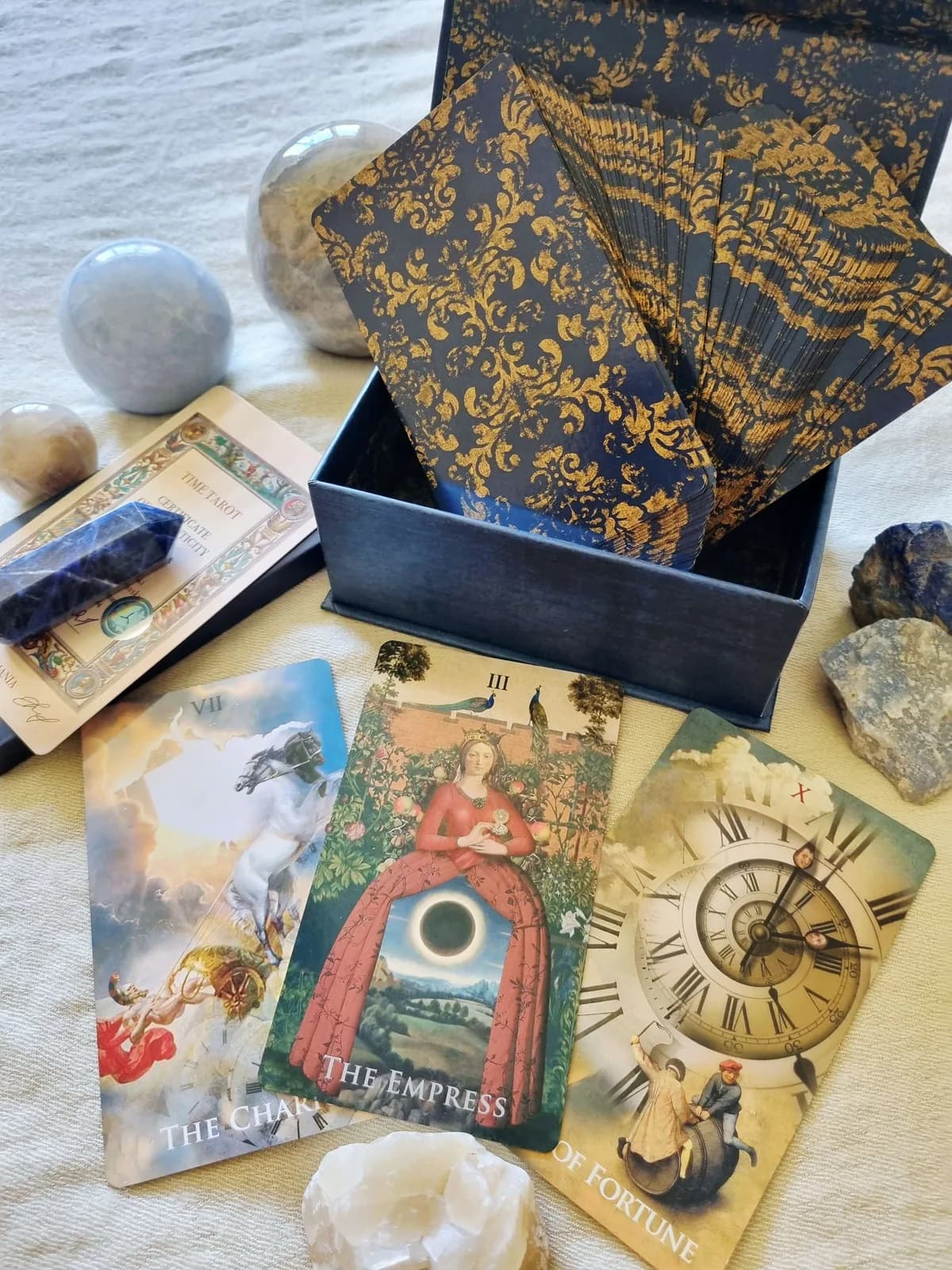
Time Tarot, created by Eugene Vinitski and Elsa Khapatnukovski of Tarotmania, takes the traditional Rider-Waite-Smith Tarot and places it within an extraordinary meditation on time, its movement, its mysteries, its cycles and its relationship with human experience.
Rather than treating time simply as a sequence of past, present and future, Time Tarot explores the idea of Divine and Cosmic Time: the notion that life unfolds within a greater rhythm and that events may arrive when the conditions are right for them to naturally reveal themselves.
It is a fascinating concept for a Tarot deck because Tarot has always been concerned with movement, cycles and transformation. The Fool begins a journey. Seasons change. Towers fall. New beginnings emerge. The Wheel turns. Nothing remains completely still.
In Time Tarot, that sense of movement becomes part of the deck's very visual language.
The result is a beautifully considered 78 card Tarot deck that remains recognisable to readers familiar with the Rider-Waite-Smith tradition while introducing an entirely new layer of symbolism through clocks, timepieces, celestial instruments and the mechanisms of measuring time.
For anyone fascinated by Tarot, symbolism, history, dreams or the mysterious rhythms of existence, this is a deck with plenty to contemplate.
The Philosophy Behind Time Tarot
At the heart of Time Tarot is a simple yet profound observation: time is continuously moving.
The past flows into the present and the present into the future. We experience our lives within that movement, making choices, remembering what has been and imagining what might come.
The creators describe their deck as being directly connected with the concept of Divine and Cosmic Time. Within this philosophy, not everything unfolds according to human plans or expectations. Some events appear to arrive according to circumstances beyond our immediate control, when the necessary conditions have been created for them to unfold.
This gives the deck an interesting philosophical quality.
Rather than encouraging us to see Tarot purely as a tool for predicting what will happen next, Time Tarot can be approached as a way of contemplating when and how things unfold.
Sometimes the answer is action.
Sometimes it is patience.
Sometimes it is recognising that something has already reached its natural conclusion....
..... and sometimes the most useful Tarot message may simply be that something is not ready yet.
This is where the concept of Divine Time becomes particularly interesting within a Tarot reading.
Instead of asking only "What will happen?", we might also ask:
"What is unfolding in its own time?"
"What am I being asked to understand before moving forward?"
"What needs to mature before the next stage can begin?"
These questions bring an entirely different dimension to a Tarot reading.
Tarot and the Movement of Time
Tarot is already filled with cycles.
The Major Arcana can be understood as a journey through changing states of consciousness and experience.
The Wheel of Fortune reminds us that circumstances change. Death marks transformation and transition. The Star brings renewal after upheaval. The World represents completion before another cycle begins.
The four suits also describe different dimensions of human experience.
Time Tarot takes these familiar structures and asks us to look at them through another lens.
Time becomes woven into the imagery rather than simply being an occasional theme.
This makes the deck particularly intriguing for readers who enjoy layered symbolism.
The traditional Tarot meanings remain present, but the visual vocabulary encourages us to think about duration, cycles, momentum, timing and the consequences of allowing events to unfold naturally.
The Four Suits Through the Language of Time
One of the most imaginative aspects of Time Tarot is the way the four traditional Tarot suits are connected with different forms of timekeeping.
The suits retain their traditional names and meanings, but each receives an additional symbolic language.
This means that the deck can still be approached through the familiar Rider-Waite-Smith system while offering another avenue of interpretation.
Wands, The Pendulum
Wands are traditionally associated with Fire, action, creativity, inspiration, energy and movement.
In Time Tarot, the Wands become connected with the pendulum.
The image is wonderfully appropriate.
A pendulum swings backwards and forwards, its movement continuing for as long as energy remains within the mechanism. It embodies rhythm, motion and repetition.
There is something almost hypnotic about the idea.
The pendulum does not remain permanently on one side. It moves.
Forward.
Back.
Forward again.
This gives the Wands a fascinating relationship with the movement of time.
In a reading, their familiar associations with action and momentum can therefore be contemplated alongside questions of rhythm and timing.
When should we act?
When should we pause?
Are we moving with the natural rhythm of something, or constantly pushing against it?
The pendulum becomes a beautiful metaphor for this continual movement.
Swords, The Hands of the Clock
Swords belong traditionally to the element of Air, representing thought, communication, intellect, conflict, truth and decision making.
In Time Tarot, their sharp forms are associated with the hands of a clock.
There is an almost immediate symbolic connection here.
Clock hands continually move forward, measuring the passing of each moment. Unlike a pendulum, which swings backwards and forwards, the clock hand relentlessly progresses around the dial.
This brings an interesting quality to the Swords.
The suit has always carried an association with clarity and sometimes uncomfortable truth.
The clock adds another reminder: time continues regardless of whether we are ready for it or not.
A decision delayed is still a decision within the movement of time.
A difficult truth may eventually need to be faced.
A moment passes whether we cling to it or release it.
The imagery therefore adds a sense of urgency and inevitability to the traditional Sword symbolism without replacing its established meanings.
Cups, The Hourglass
Cups are traditionally connected with Water, emotion, intuition, relationships, memory and the inner world.
In Time Tarot, the Cup is associated with the hourglass.
This may be one of the most poetic pairings within the deck.
Inside an hourglass, sand flows from one chamber to another. It moves steadily and visibly, creating a physical representation of time passing.
Water and sand are both fluid in their own ways.
Both flow.
Both can be contained.
Both can escape.
Both remind us that nothing remains exactly where it began.
The hourglass therefore creates a beautiful bridge between the emotional symbolism of Cups and the philosophy of time.
Our emotional lives are filled with memories of what has passed, experiences of what is happening now and hopes for what may come.
Relationships change.
Feelings evolve.
Grief softens.
Love deepens.
Healing takes time.
The hourglass becomes a quiet reminder that emotional transformation is rarely instantaneous.
Pentacles, The Astrolabe
The Pentacles bring perhaps the most celestial dimension to the deck.
Traditionally associated with Earth, material life, stability, resources, work, health and practical matters, Pentacles are represented through the symbolism of the astrolabe.
The astrolabe is an ancient astronomical instrument used to observe the heavens and work with celestial measurements.
Its inclusion introduces a fascinating relationship between earthly stability and the movement of the cosmos.
Pentacles are concerned with the tangible world, the things we build, maintain and nurture.
The astrolabe looks upward.
It connects earthly experience with the stars.
This creates a symbolic reminder that our practical lives exist within something much larger than ourselves.
The Pentacles therefore become associated not simply with material stability, but with cycles, celestial movement, navigation and the measurement of our place within the greater universe.
It is a particularly evocative interpretation of the suit.
The Major Arcana and the Mystery of Time
The Major Arcana of Time Tarot remains rooted in the classic Rider-Waite-Smith tradition. The familiar archetypes are still recognisable, allowing readers who already know the traditional Tarot system to enter the deck comfortably.
Yet the imagery has been enriched with symbols associated with clocks and time.
This is where the deck's concept becomes particularly interesting.
The Major Arcana already tells a story of transformation.
The Fool begins with possibility.
The Magician initiates action.
The High Priestess invites us into mystery.
The Empress represents creation.
The Emperor establishes structure.
The Wheel turns.
Death transforms.
The Tower disrupts.
The Star restores.
The World completes.
Viewed through the lens of time, these archetypes can become part of an even larger cycle.
Perhaps the Wheel is not merely turning circumstances.
Perhaps it is reminding us that everything moves.
Perhaps Death is not simply an ending but a transition that makes room for another stage.
Perhaps The Hermit reminds us that some answers require time rather than immediate action.
Perhaps The Hanged Man teaches us that sometimes the most significant transformation occurs when we stop trying to force the clock forward.
This is one of the strengths of the deck's concept: it does not need to abandon traditional Tarot meanings to introduce something new.
Instead, it asks us to look at those meanings from another perspective.
The Court Cards and Time
The Court Cards are also based upon the traditional Rider-Waite-Smith Tarot system, with additional visual references to time.
This creates an interesting opportunity for readers to consider not only who a Court Card might represent, but also how that person relates to timing.
Are they patient?
Impulsive?
Reflective?
Ready to act?
Holding something back?
Moving with circumstances or resisting them?
The Courts already represent different approaches to experience and maturity. The addition of time symbolism creates another subtle layer through which these personalities can be understood.
A Journey Through Past, Present and Future
One of the most natural ways to work with Time Tarot is through readings concerned with past, present and future.
Yet the deck encourages us to think beyond simple prediction.
The past can represent experience, memory and the lessons that have shaped us.
The present is the point at which awareness and choice meet.
The future is possibility, something that has not yet fully arrived.
This distinction is important.
The future is not necessarily a fixed destination. It is something we approach through the present and the present itself is constantly becoming the past.
This gives Time Tarot a particularly contemplative quality when used for journaling, meditation and personal reflection.
A simple three card reading could become:
What has the past taught me?
What is asking for my attention now?
What is beginning to emerge?
The emphasis shifts from fortune telling towards a conversation with the movement of life.
A Beautiful Deck for Tarot Reflection
Although Time Tarot can certainly be used for traditional readings, I think its concept lends itself particularly well to reflective Tarot practice.
Imagine drawing a single card each morning and asking:
"What is the lesson of this moment?"
Or at the end of the day:
"What has changed since this morning?"
A weekly reading could explore where energy is gathering, where patience is needed and what is naturally coming to completion.
For longer readings, the deck's philosophy could inspire questions around cycles and timing:
What is coming to an end?
What is beginning?
What needs more time?
Where am I rushing?
Where am I waiting unnecessarily?
What is developing beneath the surface?
What am I trying to force?
What might unfold naturally if I allow it to?
What lesson is this period of my life teaching me?
These questions feel beautifully aligned with the philosophy behind the deck.
The Artwork, A Glimpse Into Another Era
The visual style of Time Tarot draws inspiration from 16th- and 17th-century Dutch art, giving the deck a distinctly historical atmosphere.
There is something especially appropriate about this artistic direction.
The 16th and 17th centuries were periods in which art, science, exploration, astronomy and philosophical enquiry increasingly intersected.
Timepieces themselves were objects of fascination.
Clocks and scientific instruments could represent human ingenuity while simultaneously reminding us of mortality and the limits of human existence.
That historical atmosphere fits remarkably well with the deck's central concept.
The creators describe Time Tarot as a hand-drawn original project, developed over several years.
This is worth highlighting.
In an age of rapidly produced imagery, there is something meaningful about a Tarot project that has been developed slowly and deliberately over an extended period.
In a deck concerned with time, that feels almost poetic.
The deck itself has taken time to come into being.
The Quality and Presentation of Time Tarot
Time Tarot is presented as a collector quality Tarot deck, with 78 gold gilded cards housed within a luxury magnetic box.
The deck comes with a substantial 192 page companion book in English, giving readers plenty of material to explore the imagery and philosophy behind the cards.
Each deck is accompanied by a numbered and signed Certificate of Authenticity from the authors, adding an additional collector's element.
The combination of hand drawn artwork, gold gilding, luxury packaging, substantial companion book and signed, numbered certificate gives Time Tarot a presentation that feels considerably more like a special edition art object than an everyday mass market Tarot deck.
Time Tarot for Beginners
At first glance, a Tarot deck centred around Divine and Cosmic Time might sound particularly esoteric.
However, the deck retains the traditional 78-card Rider-Waite-Smith structure, including the familiar Major Arcana, Minor Arcana suits and Court Cards.
That provides a useful foundation for anyone learning Tarot.
If you already understand the basic symbolism of the Rider-Waite-Smith system, the time related imagery becomes an additional layer rather than something you have to learn from scratch.
For a beginner, the companion book provides another valuable starting point. Rather than needing to memorise every new system immediately, the reader can begin with traditional Tarot meanings and gradually explore how the symbols of time influence their interpretation.
This makes the deck approachable while still offering plenty of depth for experienced readers.
Time Tarot for Experienced Readers
For experienced Tarot readers, the attraction may be rather different.
Once the basic meanings of the cards are familiar, the real pleasure comes from discovering additional layers of symbolism.
The pendulum, clock hands, hourglass and astrolabe offer new visual prompts without dismantling the traditional structure.
Experienced readers might therefore find themselves noticing things they had never previously considered about familiar cards.
A card associated with action may suddenly raise a question about rhythm.
A card associated with thought may suggest the pressure of passing time.
An emotional card may evoke memory and impermanence.
A material card may become connected with celestial cycles and navigation.
This creates plenty of room for personal interpretation.
A Deck for Collectors
There is also no denying that Time Tarot has strong appeal as a Tarot collector's deck. The hand drawn artwork, historical aesthetic, gold gilded cards, luxury magnetic box, substantial companion book and signed and numbered Certificate of Authenticity all contribute to its sense of occasion.
But perhaps the most appealing aspect is that the collectible qualities do not appear to exist independently of the deck's concept.
Everything comes back to time.
The historical artistic inspiration.
The antique timekeeping instruments.
The philosophy of Divine Time.
The deliberate development of the artwork.
Even the numbered certificate quietly reinforces the idea of a particular moment in the deck's own history.
What Makes Time Tarot Different?
There are countless Tarot decks available today, so what makes a deck memorable is often its ability to offer a genuinely coherent concept.
With Time Tarot, the theme is not simply decorative.
Time appears throughout the deck's symbolic architecture.
The four suits have their own timekeeping language.
The Major Arcana incorporates temporal imagery.
The Court Cards are enriched with the theme.
The artwork draws upon historical influences and beneath everything sits a philosophy about the way life unfolds.
This gives the deck a strong internal identity.
It is not simply a Rider-Waite-Smith deck with clocks added to the artwork.
It is an exploration of what Tarot might say when viewed through the lens of time.
My Thoughts on Time Tarot
What I find particularly intriguing about Time Tarot is that its philosophy encourages us to slow down. That might sound like an odd thing for a deck about time.
Yet perhaps that is exactly the point.
We live in a culture that often encourages immediacy. We want answers quickly. We want certainty. We want to know what happens next.
Tarot can easily become caught up in that desire for prediction.
Time Tarot offers another possibility.
Perhaps the cards can help us understand where we are within a process rather than simply telling us what the destination will be.
Sometimes the message may be about action.
Sometimes patience.
Sometimes preparation.
Sometimes acceptance....
.... and sometimes simply recognising that we cannot hurry something that has its own rhythm.
For me, this is where the concept of Divine Time becomes particularly beautiful.
It encourages a relationship with Tarot that is less about trying to control the future and more about becoming aware of the present moment.
The clock continues.
The pendulum swings.
The sand falls.
The stars move....
.... and we move with them.
Time Tarot by Eugene Vinitski and Elsa Khapatnukovski is an intriguing meeting of traditional Tarot, historical artwork, timekeeping symbolism and philosophical reflection.
Its Rider-Waite-Smith foundation makes the deck accessible to readers already familiar with traditional Tarot, while the carefully developed language of time provides additional layers for interpretation.
The pendulum Wands, clock-hand Swords, hourglass Cups and astrolabe Pentacles are particularly compelling examples of how a familiar Tarot system can be reimagined without losing its foundations.
Beautifully presented with gold gilded cards, a luxury magnetic box, a 192-page English companion book and a numbered and signed Certificate of Authenticity, it also has considerable appeal for Tarot collectors.
But beyond the beautiful presentation lies the heart of the project: a meditation on the mysterious substance through which every human life unfolds.
Perhaps the greatest invitation of Time Tarot is not to ask simply:
"What happens next?"
but instead:
"What is this moment asking me to understand?"
Because sometimes the wisdom we seek is not about knowing the future.
Sometimes it is about learning to recognise the right time.
Frequently Asked Questions About Time Tarot
Is Time Tarot a traditional Tarot deck?
Yes. Time Tarot is a 78 card Tarot deck based on the Rider-Waite-Smith tradition. It retains the traditional Major Arcana, Minor Arcana suits and Court Cards while adding symbolism connected with time.
What is the theme of Time Tarot?
The central theme is Divine and Cosmic Time. The deck explores how human experience unfolds through past, present and future and the idea that events may unfold according to a greater rhythm beyond our individual plans.
What do the suits represent in Time Tarot?
The traditional suits are retained but enriched with time-related symbolism. Wands are connected with pendulums, Swords with clock hands, Cups with hourglasses and Pentacles with astrolabes.
Is Time Tarot suitable for beginners?
Yes. Because the deck is based upon the Rider-Waite-Smith Tarot, beginners have a familiar symbolic foundation from which to learn. The companion book provides additional guidance.
Is Time Tarot suitable for experienced Tarot readers?
Absolutely. Experienced readers may particularly enjoy the additional symbolic layers and the opportunity to explore familiar Tarot archetypes through the concept of time.
How many cards are in Time Tarot?
Time Tarot contains 78 cards: the traditional 22 Major Arcana and 56 Minor Arcana cards.
Does Time Tarot come with a guidebook?
Yes. The deck includes a 192 page companion book in English.
Is Time Tarot collectible?
The deck has several qualities that may appeal to collectors, including its hand-drawn artwork, gold gilded cards, luxury magnetic box and numbered and signed Certificate of Authenticity. The first edition was released in February 2025 as a limited run of 1,000 copies.
What is the artistic style of Time Tarot?
The visual style was inspired by 16th and 17th century Dutch art, giving the deck a distinctive historical and atmospheric character.
What does Time Tarot explore?
At its heart, Time Tarot explores the relationship between Tarot and the movement of time, including cycles, timing, past and future, patience, transformation and the idea of Divine or Cosmic timing.